
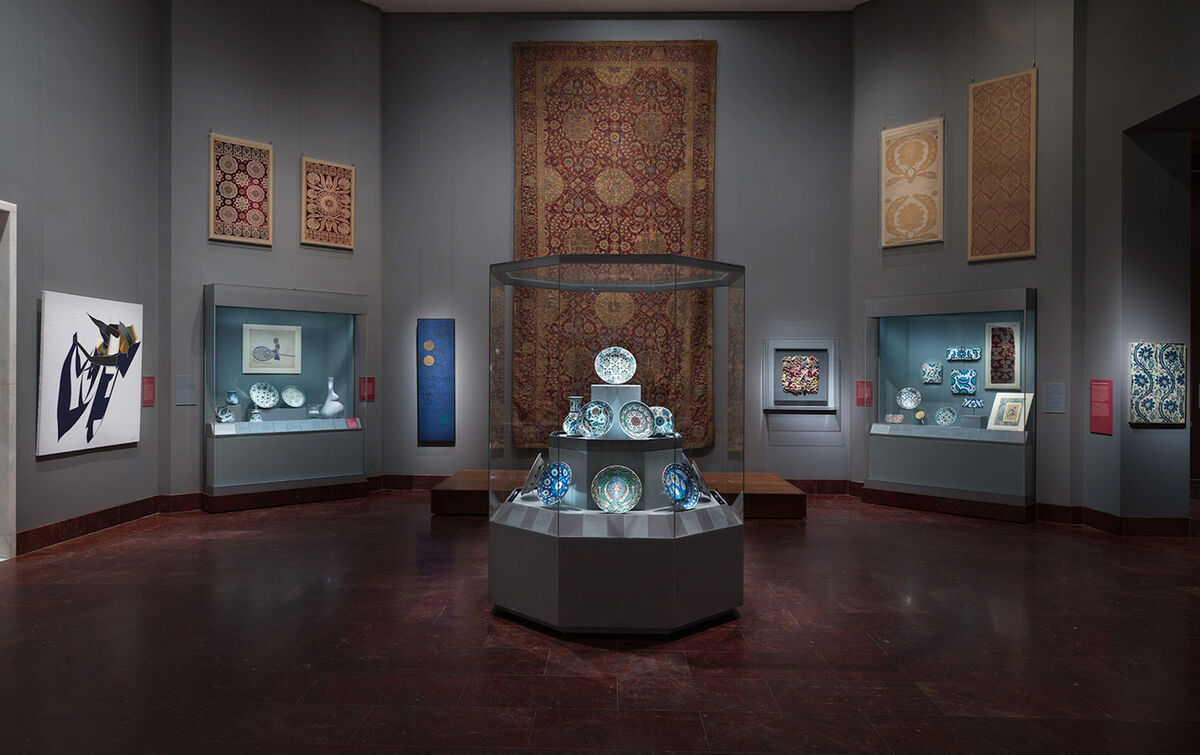
As modern-day Türkiye marks its hundredth year, Koç Family Galleries 459 and 460 devoted to the arts of the Ottoman world, highlight seven modern and contemporary works that engage with the Islamic and Ottoman cultural legacy. These works reflect the creative approaches to the Ottoman past pursued by three generations of artists from Türkiye and elsewhere. Some take pride in their links to historical traditions; others reject that legacy but remain subconsciously rooted in Ottoman culture. Modern preoccupations include the arts of calligraphy and ornament, along with the traditions of manuscript painting, textile weaving, and ceramics production. By repurposing these hallmarks of Ottoman art, some artists of the twentieth and twenty-first centuries confront gender, taboos, and other aspects in modern Türkiye.
This intervention puts the modern and contemporary works into conversation with their Ottoman forebears to ask the following questions: What defines modern Turkish art? How does it differ from “craft,” especially in light of Türkiye’s rich ceramic and textile traditions? Each of the featured artists has developed a distinct artistic identity by employing, renewing, or diverging from the styles, modes, and creative traditions of the Ottoman past—while also incorporating the methods and principles of twentieth and twenty-first century Turkish, European, and American art. The dialogues between these modern and historical works bridge gaps of time and space to join a greater, global dialogue of modernity.
Elif Uras’s work pays tribute to Turkish women and to Anatolia’s material and cultural past. Since 2007, Uras has engaged the artistic traditions of the town of Iznik, celebrated for its ceramic production during the Ottoman Empire. Today, tasks that were historically performed by men are managed by women artisans and entrepreneurs. Uras’s voluptuous vessels center the female figure, sometimes evoking the pregnant belly, in an homage to the modern women of Iznik. Pregnant Haliç II takes its name, spiraling floral decoration, and blue-and-white color palette from a group of sixteenth century Iznik ceramics discovered in the Haliç (Golden Horn) neighborhood of Istanbul.
Curator in the Department of Islamic Art: Deniz Beyazıt. The installation featured works by Erol Akyavaş, Aliye Berger, Burçak Bingöl, Burhan Doğançay, Peter Hristoff, Gülay Semercioğlu, Elif Uras, and Mohamed Zakariya.
